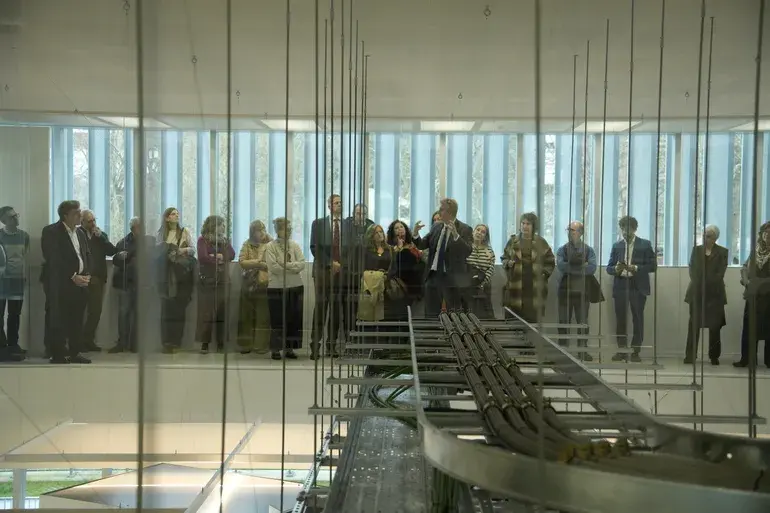
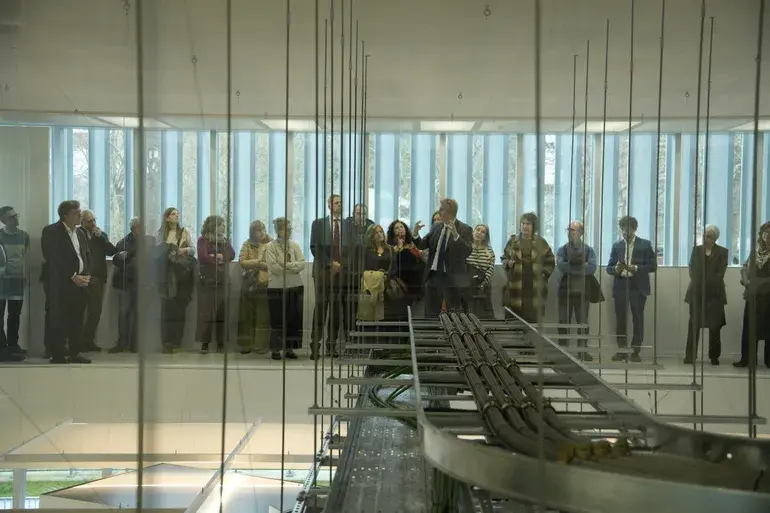
A delegation from the european commission visits the quantum computer located in the Ikerbasque building, co-financed by European Union
February 18, 2026The event served to present one of the most emblematic investments of the RIS 3 Euskadi 2030 smart specialisation strategy.
The quantum computer, IBM Quantum System Two, inaugurated last October in the Ikerbasque building in Donostia, was visited today by a delegation from the European Commission and representatives from the Directorate-General for European Funds of the Ministry of Finance. The event, organised within the framework of the Basque Country ERDF Programme 2021-2027, served to present one of the most emblematic investments of the RIS 3 Euskadi 2030 smart specialisation strategy, as well as to confirm the high level of execution of European funds in the Basque Country.
The visit to the computer, co-financed by the European Union as part of its contribution to the objectives of the Strategic Technologies for Europe (STEP) platform, was led by Vicente Rodríguez, Senior Expert at the European Commission's Directorate-General for Regional and Urban Policy, and Anais Vega and Pedro Cortegoso, from the Directorate-General for European Funds of the Ministry of Finance. The Deputy Minister for Science and Innovation of the Basque Government, Adolfo Morais, hosted the event, which was also attended by the Deputy Minister for Financial Policy and Budgets, José Enrique Corchón, and the Director of Economic Policy and European Cohesion, Juan Alberdi. The institutional representation was completed by the Provincial Councillor for Finance of Gipuzkoa and officials from the Basque Government's science and innovation department.
The scientific director of the Basque Quantum strategy, Javier Aizpurua, was responsible for guiding attendees around the facilities and explaining the Basque strategy in the field of applied quantum technologies, in which the IBM Quantum System Two plays an essential role. During his speech, Aizpurua stressed that this quantum computer ‘represents a key asset for the strategic autonomy and technological sovereignty of the European Union; an industrial tool designed to transform strategic sectors of the economy by offering computing capabilities that are impossible for conventional systems’.
Today's visit is particularly relevant in the context of the European Union's strategy to achieve technological sovereignty in the field of quantum computing. This facility is in line with the priorities set out in the EuroHPC Regulation and with initiatives such as the European Framework Partnership Agreement Pilot Line, which establishes long-term collaborations to drive the transition of quantum technologies from research to industrial production, in which the Basque Country is collaborating through the Basque Quantum strategy.
In the opinion of Javier Aizpurua, scientific director of BasQ, ‘this publication represents a very important step on the path we have been following since the inception of Basque Quantum. It is the result of the joint work of research teams from the CFM-MPC and the DIPC, in close collaboration with IBM, and demonstrates how this cooperation allows us to open up new lines of research and advance our understanding of complex quantum phenomena’.
A visit that confirms the programme's success
During the tour, the Deputy Minister for Financial Policy and Budgets, José Corchón, emphasised to the European representatives that these new facilities are an example of what the Basque Country ‘understands as how we should build Europe: by committing to innovation and promoting the strength of joint work in favour of a more accessible, efficient and cohesive policy for the benefit of citizens’.
He went on to highlight the value of the Basque management model: ‘We have demonstrated our ability to implement and certify the entire previous programme, even in a context marked by Covid-19. That is what we offer Europe: efficiency, rigour and transparency’.
Corchón recalled that, at the end of 2025, the Basque Country had certified €58.4 million from the 2021-2027 ERDF programme, well above the minimum threshold required by the n+3 rule. ‘This guarantees that every euro invested will benefit citizens: in training, in support for SMEs and in the modernisation of public services,’ he added.
The Deputy Minister explained to the delegation that this quantum computer is not an end in itself, but is ‘fully aligned with the Innovation Beacons of the 2030 Science, Technology and Innovation Plan, which guide our action towards technological, digital and energy transformation’.
Deputy Minister Corchón also took advantage of the presence of the EU authorities to reiterate the Basque Government's position on the proposed Multiannual Financial Framework (MFF) 2028-2034. The Basque Country welcomes the fact that competitiveness and innovation are positioned as strategic axes, but rejects the creation of a single national plan per Member State, requests a thorough review of the Commission's proposal and reiterates the firm commitment of the Basque institutions to continue collaborating with the European institutions in order to strengthen the European project and preserve its fundamental values. ‘This unification undermines the specific objectives of each policy and, in fact, undermines social and territorial cohesion. We advocate maintaining regional programmes with their corresponding allocations and their space for direct dialogue with the European Commission,’ he warned.
For his part, the Deputy Minister for Science and Innovation, Adolfo Morais, stressed that the fundamental contribution of this infrastructure is to provide companies and public institutions with responsibilities in technological development with preferential access to state-of-the-art quantum computing services and infrastructure. ‘All of this will serve,’ he stressed, ‘as a platform for the development of projects and use cases that, among other things, will optimise business processes by reducing time and costs, enable complex problems to be solved more efficiently, and facilitate the exploration of new solutions, products, and services that are not feasible with current classical computing systems.’
In this regard, Morais stressed that "the quantum computer reinforces the competitiveness of the Basque Country and Europe, strengthening their resilience and productivity. It is a strategic investment in future capabilities that will ensure the adaptation of the economic, industrial and technological base to the ecological and digital transitions, including those that contribute to the goals and objectives of the EU's Strategic Programme for the Digital Decade 2030 and the promotion of innovation in deep technologies."
‘The Basque Quantum (BasQ) strategy offers us the opportunity to promote European and international leadership from a threefold perspective: having a solid system; having the most advanced technology; and developing our own science and technology that will put us on the path to techno-scientific sovereignty,’ he concluded.
Today's meeting also served as a prelude to the 6th ERDF Programme Monitoring Committee, which will be held tomorrow in Bilbao and will address in greater detail the expenditure forecasts and new projects that will continue to consolidate the Basque Country as a benchmark for innovation within the European Union.