Pérez Iglesias invites European regions to collaborate on the BasQ strategy to strengthen the EU's technological sovereignty
February 11, 2026At the Leaders Meeting- Fit for the Future, representatives from 14 European industrial regions learned about the Basque Quantum project. The Minister for Science, Universities and Innovation emphasised that the current global context, ‘despite its threats’, represents an opportunity for territories committed to disruptive innovation
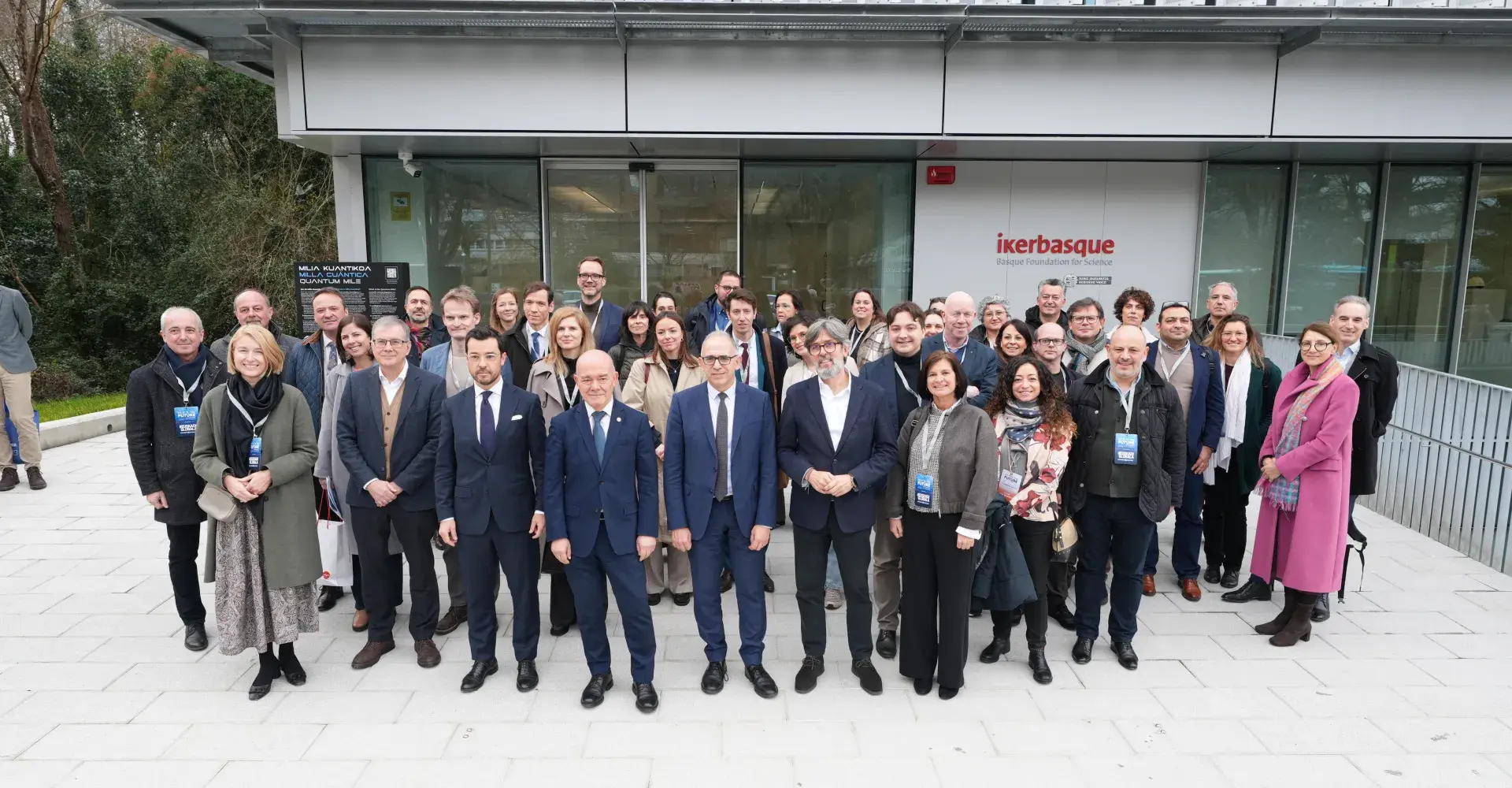
The Minister for Science, Universities and Innovation, Juan Ignacio Pérez Iglesias, welcomed institutional delegations from 14 European regions participating in the Leaders Meeting - Fit for the Future event to Donostia/San Sebastián this week. The meeting took place at the Ikerbasque building, where the Minister presented the Basque strategy on quantum technologies, Basque Quantum, and opened up avenues for interregional cooperation.
The European representation included 14 industrial regions with great innovative and economic potential, including, in addition to the Basque Autonomous Community, Flanders, Wallonia, Hauts-de-France, Grand Est, Navarre, Upper Austria, Catalonia, Lombardy, Saxony, Baden-Württemberg, West Pomerania, Emilia-Romagna and Auvergne Rhone Alpes.
The meeting was also attended by the Secretary General for External Action and Euskadi Global, Ander Caballero; the Deputy Minister for Science and Innovation, Adolfo Morais; and the Director of Quantum Computing at IBM Spain, Mikel Díez.
During his speech, the minister highlighted the importance of innovation and collaboration in addressing the technological challenges of the present and the future. ‘Europe needs to develop the technological capacity that will give us strategic sovereignty, and the regions have a key role to play in this endeavour. The Basque Government has intensified its efforts to promote disruptive innovation based on cutting-edge science,’ he stressed.
In this regard, he explained that the Basque Government has redesigned its science and innovation policy, focusing its strategy on ten areas of specialisation, including quantum technologies through the Basque Quantum (BasQ) project. This project aims to make the Basque Country a European benchmark in quantum science and technologies, projecting its impact both internally and internationally.
The minister explained that BasQ follows two complementary lines. On the one hand, it provides the research community—and soon the business community—with the capabilities of the IBM Quantum System Two. On the other, it incorporates a line of research and innovation to produce its own silicon-based quantum chips, in collaboration with the company Quantum Motion. Pérez Iglesias indicated that the purpose of these two lines is to contribute ‘significantly’ from the Basque Country to the ‘long-awaited European technological sovereignty’.
In this regard, he underlined the Basque Government's willingness to establish alliances. ‘The spirit of collaboration permeates the BasQ strategy,’ said the minister, who extended to European representatives an ‘explicit and firm invitation to collaborate with the Basque Country on the BasQ project’.
In his analysis of the current scenario, Pérez Iglesias referred to the complexity of the global situation, alluding to the expression ‘interesting times’ and its connotation of instability. The minister acknowledged that these are ‘turbulent and threatening times,’ but added that this situation also represents ‘a time full of opportunities for countries and regions committed to disruptive innovation and technological leadership.’
‘Technological capacity as a strategic element’
For his part, the Secretary General of External Action and Euskadi Global, Ander Caballero, framed this visit within the urgent need for Europe to move towards strategic sovereignty. Caballero warned that we are at a ‘decisive moment’ in which geopolitical uncertainty and technological competition are redefining European priorities.
‘Technological capacity has become a strategic element,’ said the Secretary General, emphasising the fundamental role of the territories in this process. According to Caballero, the regions not only implement policies, but also actively contribute to the design of European autonomy through public-private partnerships. ‘From the Basque Country, we want to contribute to the strategic sovereignty of the EU, strengthen industrial competitiveness and promote innovation,’ he concluded.
Likewise, the director of Quantum Computing at IBM Spain, Mikel Díez, stressed that the BasQ initiative "represents an opportunity to lead the development and application of quantum technologies, positioning the Basque Country as a global benchmark. BasQ and IBM are already making great strides using cutting-edge quantum computing technology, paving the way for its applicability at scale and its transfer to industry and society."
‘And if you are looking to get involved in quantum technology, are passionate about science and research, or represent a technology-based start-up, there are few places in the world more suitable for this than the Basque Country,’ added Diez.
Finally, the Deputy Minister for Science and Innovation, Adolfo Morais, highlighted that the field of quantum science and technology ‘is advancing rapidly and its impact is already a reality in the scientific field and is beginning to be felt in the business and industrial fields. The quantum advantage is a reality.’
This meeting is part of the Leaders Meeting agenda, a forum that brings together territories with high industrial potential in the Basque Country to address common challenges in competitiveness and innovation.